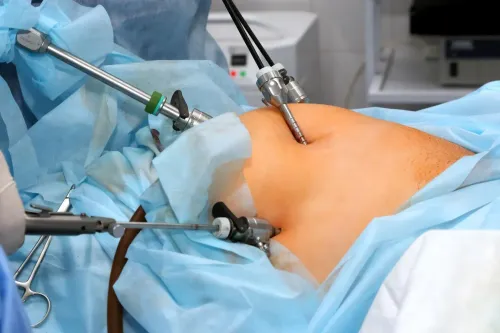
Obesity and a hernia can change the safest order, technique and timing of surgery. You will be able to identify urgent symptoms, understand the tests and decisions involved, and compare a bariatric, open, laparoscopic or robotic plan without treating the word “robotic” as the whole answer.
Key takeaways
- Seek urgent assessment for severe pain, vomiting, or a hernia that will not go back in.
- Weight loss before repair can reduce risk, but delaying surgery is unsafe for an obstructed hernia.
- Compare open, laparoscopic and robotic repair based on hernia details and surgical expertise.
- Ask about recurrence prevention, anaesthesia risk, hospital support and the complete treatment plan.
What a bariatric surgeon adds when obesity and a hernia occur together
Yes, consult a bariatric surgeon when obesity and a hernia occur together, especially if weight-loss surgery is being considered. Obesity increases abdominal pressure, anaesthetic risk, wound problems and recurrence pressure after repair. The consultation should coordinate weight reduction, nutrition, reflux treatment and the timing of hernia surgery. It should not automatically lead to robotic repair.
The hernia assessment should identify the specific problem:
- Inguinal hernia: groin weakness that may affect walking or lifting.
- Umbilical or epigastric hernia: defects around or above the navel.
- Ventral or incisional hernia: an abdominal-wall defect, including one in a previous surgical scar.
- Recurrent hernia: a repair that has failed or returned.
- Hiatal hernia: stomach displacement through the diaphragm, often assessed alongside reflux and a bariatric procedure.
A bariatric surgeon in Pune may offer useful expertise in obesity, metabolic preparation and combined operative planning, but bariatric training alone does not prove skill in complex abdominal-wall reconstruction. Ask specifically about ventral, incisional, groin and recurrent repairs, mesh placement, defect closure, component separation and treatment of complications.
For hernia problems before robotic surgery, examination may be enough for a straightforward groin lump; CT is commonly useful when obesity, recurrence, multiple defects, a large ventral hernia or uncertain anatomy makes planning harder. A painful irreducible lump, vomiting, distension, fever or skin colour change requires immediate assessment, not a routine robotic consultation.
When a hernia needs urgent assessment before any robotic consultation
A painful hernia that cannot be pushed back requires same-day medical assessment. Go to an emergency department immediately if it is accompanied by vomiting, increasing abdominal swelling, inability to pass stool or gas, fever, or red, purple, blue or black skin over the lump.
These signs can indicate bowel obstruction or strangulation, where trapped bowel is losing its blood supply. Do not wait for a robotic-surgery consultation.
The surgeon will assess urgency and anatomy in this order:
- Ask when the bulge and pain began, whether vomiting or bowel changes followed, and whether you have had previous abdominal operations.
- Examine you standing and lying down, including the lump’s tenderness, skin colour, size, cough impulse and reducibility.
- Check vital signs and abdominal tenderness; urgent findings can change the plan from elective repair to emergency surgery.
| Assessment method | What it establishes | When it is useful |
|---|---|---|
| Physical examination | Location, tenderness, reducibility and likely groin or abdominal-wall defect | Many uncomplicated groin hernias |
| Ultrasound | A superficial defect and its movement with straining | Uncertain groin or small abdominal-wall lumps |
| CT scan | Defect size, contents, multiple defects, obstruction and loss of domain | Obesity, recurrent or complex ventral hernia, prior surgery, or uncertain diagnosis |
CT helps plan mesh position and the operative route, but severe symptoms take priority over scheduling scans. A normal-looking scan cannot override worsening pain, vomiting or a trapped, discoloured bulge.
Should you lose weight before hernia repair or combine the operations?
The safest sequence depends on hernia urgency, anatomy, planned weight loss and nutritional readiness—not body mass index alone. A painful, irreducible hernia, obstruction, skin colour change, vomiting or abdominal distension requires urgent assessment; delaying repair for weight loss can become dangerous.
1. Repair the hernia first when it is incarcerated, obstructing, rapidly enlarging or too symptomatic to wait. The surgeon may use examination and CT to define a large, recurrent or complex ventral defect before operating.
2. Perform bariatric surgery first when the hernia is reducible, stable and unlikely to obstruct during the weight-loss period. Losing weight can reduce anaesthetic and wound risks and lower pressure on the repair. The hernia is then repaired after weight and nutrition have stabilised.
3. Combine both operations only when the hernia is suitable for the planned approach and the patient can tolerate a longer, more complex procedure. Operating in a potentially contaminated field can affect mesh selection and infection risk, so the surgeon must explain that trade-off.
4. Choose staged repair after weight loss for a large ventral, incisional or recurrent hernia when weight reduction is realistic and postponement is safe. Do not delay solely to reach an arbitrary target.
| Option | Best fit | Main concern |
|---|---|---|
| Hernia first | Urgent or high-risk defect | Weight-related recurrence |
| Bariatric first | Stable, reducible hernia | Interim incarceration |
| Combined | Selected anatomy and risk profile | Longer operation and mesh concerns |
| Repair after weight loss | Planned complex reconstruction | Delay while losing weight |
How obesity changes the choice between open, laparoscopic and robotic repair
Obesity can make a small hernia technically demanding, but it does not make robotic repair automatically superior. Compare the planned anaesthesia, access, mesh position, defect closure, recovery and complication plan for your specific hernia.
| Approach | Anaesthesia and technical issues | Mesh and defect closure | Recovery and trade-offs |
|---|---|---|---|
| Open | Local, regional or general anaesthesia may suit selected repairs; thick abdominal tissue can make exposure and wound closure difficult. | Mesh choice and plane depend on the defect; primary closure may be possible for a small defect. | Avoids pneumoperitoneum but has a larger wound, with higher wound-infection and healing concerns in obesity. |
| Laparoscopic | Usually requires general anaesthesia and abdominal insufflation; long instruments can make suturing and dissection difficult. | Mesh commonly covers the defect without closing it, although closure is feasible in selected cases. | Smaller skin wounds and faster early recovery, balanced against bowel injury, seroma and fixation-related pain. |
| Robotic | Usually requires general anaesthesia; wristed instruments and three-dimensional vision can help with difficult dissection and sutured closure. | Facilitates precise closure and mesh placement in a chosen tissue plane, but does not replace sound reconstruction. | May reduce wound burden, yet operating time and equipment cost can be higher. |
The word robotic surgery for hernia problems does not prove better long-term results. Ask whether the surgeon expects lower recurrence from closing your defect, placing adequate mesh overlap and selecting the correct plane—not simply from using a robot.
Recurrence also depends on smoking, diabetes control, prior repairs, mesh infection, seroma, lifting restrictions and weight change. Compare the hospital’s anaesthesia assessment, postoperative monitoring, emergency cover and plan for infection, chronic pain, recurrence or conversion to open surgery before consenting.
How to compare a hernia surgeon and hospital in Pune before consenting
A useful hernia surgery comparison pune starts with matching cases: primary with primary, recurrent with recurrent, and groin with groin or ventral with ventral. Ask about the defect size, mesh plane, anaesthesia, expected recovery and package exclusions—not just the headline fee or the word “robotic.”
Ask the surgeon:
- Who will perform each part of the operation, and how many inguinal, umbilical, incisional, ventral and recurrent repairs do you perform?
- Do I need an examination scan or CT to map multiple defects, a large hernia, recurrence or loss of domain?
- Where will you place the mesh, and how will you close the defect?
- What happens if I develop bleeding, infection, chronic pain, seroma or recurrence?
- What are the lifting limits, wound-care instructions, thrombosis-prevention plan and return-to-work estimate?
Use this hospital comparison:
| Check | Ask specifically | Why it matters |
|---|---|---|
| Surgeon | Is the operating surgeon registered, and does a bariatric background include complex abdominal-wall reconstruction? | Bariatric expertise alone does not prove hernia expertise. |
| Hospital | Is there 24-hour emergency, anaesthesia, imaging and intensive-care support? | Complications need rapid treatment. |
| Package | Are mesh, tests, anaesthesia, medicines and readmission included? | A low quote can omit major costs. |
| Follow-up | Who reviews infection, recurrence or persistent pain? | Recovery continues after discharge. |
For robotic hernia surgery pimpri chinchwad, proximity helps with reviews but does not establish quality. Dr.Nikhil Jillawar 08048037739 can be one clinician to include in the same like-for-like questioning process.
Related services
Robotic Surgery in Pimpri Chinchwad, Pune Robotic Surgery in Pimpri Chinchwad, Pune Robotic Surgery is an advanced form of minimally invasive surgery that uses a robotic-assisted surgical system to help surgeons perform complex... View service → |
Laparoscopic Hernia Surgery in Pimpri-Chinchwad, Pune Laparoscopic Hernia Surgery in Pimpri-Chinchwad, Pune Laparoscopic Hernia Surgery is a minimally invasive surgical technique used to repair different types of hernias through small incisions. Dr. View service → |
Frequently asked questions
What does a bariatric surgeon add when obesity and a hernia occur together?
A bariatric surgeon can coordinate weight reduction, nutrition, reflux treatment, anaesthetic planning and the timing of hernia repair. The consultation does not automatically mean robotic surgery.
When does a hernia need urgent assessment before a robotic consultation?
Seek urgent medical assessment for severe or worsening pain, vomiting, abdominal swelling, fever, a tender lump, skin colour changes, or a hernia that cannot be gently pushed back. These signs can indicate obstruction or strangulation.
Should you lose weight before hernia repair or combine the operations?
The decision depends on hernia size, symptoms, obstruction risk, obesity-related surgical risk and whether bariatric surgery is appropriate. Do not delay an urgent repair for weight loss.
How does obesity affect the choice between open, laparoscopic and robotic hernia repair?
Obesity can increase wound complications, anaesthetic difficulty, abdominal pressure and recurrence risk. The best approach depends on the hernia location and size, previous operations, mesh plan, surgeon experience and hospital facilities.
How should you compare a hernia surgeon and hospital in Pune?
Ask who will perform the operation, how the surgeon manages obesity and complex hernias, which repair methods are suitable, what mesh is planned, how complications are handled, and what follow-up is included.