A hernia is an opening or weak area in the abdominal wall that allows fat or intestine to push through, but the right treatment depends on its location, size, symptoms and your health. By the end, you will know when observation is reasonable, when repair is urgent, how TEP and TAPP differ, and which questions to ask before choosing laparoscopic or open surgery.
Key takeaways
- Seek emergency care for severe pain, vomiting, or a firm bulge that will not reduce.
- Choose watchful waiting only after a clinician assesses symptoms, hernia type, and risk.
- Ask whether laparoscopic, open, or robotic repair best fits your hernia and health.
- Confirm mesh choice, recovery limits, warning signs, and follow-up before surgery.
What type of hernia do you have, and when is it an emergency?
A hernia is a weakness or opening in the abdominal wall through which fat or intestine pushes. A visible or palpable bulge that increases with standing, coughing or lifting, along with pressure or pain, is a common clue.
Inguinal hernias occur in the groin, femoral hernias below the groin crease, umbilical hernias at the navel, and epigastric hernias between the breastbone and navel. Incisional hernias develop through a previous surgical scar; parastomal and other abdominal-wall hernias occur around a stoma or less typical defect.
| Type | Location or cause | Typical clue |
|---|---|---|
| Inguinal | Groin canal | Bulge into the groin or scrotum |
| Femoral | Upper inner thigh | Lump below the groin crease |
| Umbilical | Navel | Bulge at or beside the belly button |
| Epigastric | Upper midline abdomen | Lump between breastbone and navel |
| Incisional | Previous operation scar | Bulge along the scar |
| Parastomal | Around a stoma | Swelling beside the stoma |
A clinician usually diagnoses an obvious hernia by asking when the lump appears and examining you while standing, coughing or straining. Ultrasound helps when examination is uncertain or the hernia is occult; CT is useful for recurrent, complex or complicated hernias. Routine imaging is not needed for every obvious, reducible groin hernia.
For hernia surgery explained Pune searches, diagnosis must come before choosing laparoscopic treatment.
Seek emergency assessment, not a routine appointment, if the bulge becomes painful and cannot be pushed back, or if you develop vomiting, abdominal swelling, inability to pass stool or gas, fever, or red, purple or dark skin over the lump. These signs can indicate obstruction or strangulation.
When should you watch a hernia, and when should you repair it?
Not every hernia needs immediate surgery. Watchful waiting can suit a man with an asymptomatic or minimally symptomatic inguinal hernia who understands the chance of future symptoms and can reach medical care quickly. This approach is less reassuring for women because a femoral hernia is easier to miss and emergency presentation is more concerning.
Belts, weight loss and avoiding lifting may reduce discomfort, but they do not close the abdominal-wall defect. Elective repair becomes more relevant when you develop:
- Increasing pain or repeated symptoms
- Enlargement of the bulge
- Activity or work limitations
- A lump that no longer reduces easily
Obesity, smoking, uncontrolled diabetes, chronic cough and constipation can increase anaesthetic difficulty, wound problems and recurrence risk. Treating these issues and losing weight can improve safety, but do not delay urgent treatment for incarceration, obstruction, strangulation or steadily worsening symptoms.
With severe obesity, staged bariatric surgery followed by hernia repair may reduce recurrence risk. A simultaneous operation can suit selected patients, but timing requires individual assessment rather than a universal rule.
Understanding laparoscopic hernia treatment with a bariatric surgeon in Pune includes discussing both operations; a search for bariatric surgeon Pune laparoscopic hernia should not replace that discussion.
| Repair | Main point | When it fits |
|---|---|---|
| Mesh | Lower recurrence for most adult groin hernias | Standard choice in many patients |
| Shouldice | Non-mesh tissue repair | Selected patients with an experienced surgeon |
“Mesh-free” does not automatically mean safer or better.
What happens during laparoscopic hernia treatment?
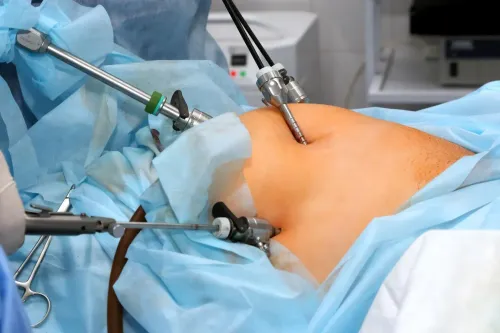
General anaesthesia comes first. After several small ports are placed, the surgeon identifies the defect, frees and returns trapped fat or intestine to the abdominal cavity, then covers the weakness with mesh in the correct tissue plane. The ports are removed and the skin is closed with sutures or surgical glue.
For a groin hernia, the approach is selected after assessing its location, size, contents, primary or recurrent status, and relationship to vessels, bowel and bladder.
| Approach | Working route | Mesh placement and planning |
|---|---|---|
| TEP | Creates a working space outside the abdominal cavity | Mesh lies in the preperitoneal plane; useful when avoiding entry into the abdomen is preferred |
| TAPP | Enters the abdominal cavity before reaching the groin | Mesh lies in the preperitoneal plane after the peritoneum is closed; it also allows inspection of both groins |
| Ventral or incisional | Enters through abdominal ports with planning around the abdominal-wall defect | Mesh position, defect closure and possible abdominal-wall reconstruction depend on size, location and previous operations |
The choice between TEP and TAPP depends on prior surgery, anatomy, surgeon experience and whether both groins need inspection or repair. A groin technique cannot simply be applied to an umbilical, ventral or incisional hernia.
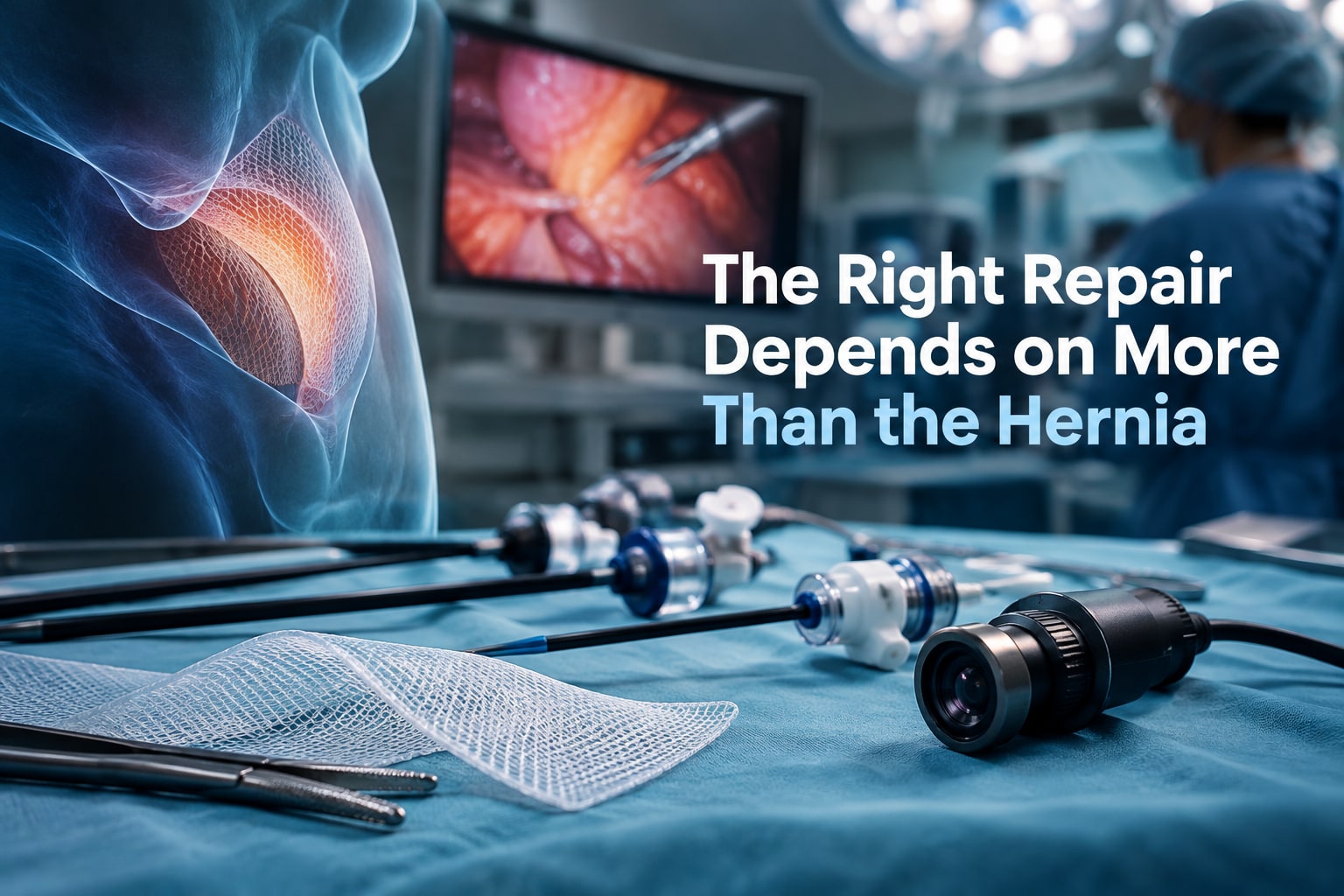
Mesh is used for most adult groin repairs because it lowers recurrence compared with many non-mesh repairs. It does not guarantee freedom from recurrence or chronic pain. These details matter when comparing laparoscopic hernia treatment in Pimpri Chinchwad.
How do laparoscopic, open and robotic repairs compare?
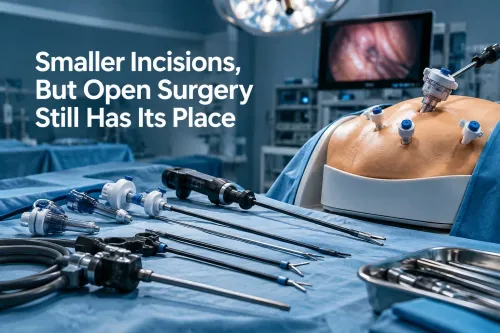
The best approach depends on the hernia, your health and the surgeon’s experience—not simply on choosing the smallest incisions.
| Option | What it involves | When it may fit |
|---|---|---|
| Open repair | An incision directly over the hernia; local, regional or general anaesthesia, depending on the case | A single accessible hernia, anaesthetic concerns or anatomy that makes laparoscopy less suitable |
| Laparoscopic repair | Abdominal ports under general anaesthesia; groin repairs use TEP or TAPP to place mesh in the preperitoneal plane | Both groins need repair, or a hernia has returned after an anterior open repair |
| Robotic repair | Robotic instruments assist the same minimally invasive principles | Selected complex or recurrent cases when the surgeon has a clear reconstructive advantage |
Laparoscopy can reduce early pain and speed normal activity compared with open anterior repair. The difference may be smaller for one straightforward hernia. Prior abdominal surgery, complex anatomy, anaesthetic risk or limited local expertise can reverse the preference.
TEP and TAPP are not risk-free. Bleeding, bowel or bladder injury, vascular injury, port-site problems and conversion to open surgery are recognised risks. Robotic repair is not automatically better: short-term results are broadly similar to conventional laparoscopy, while operating time and cost are usually higher.
For someone comparing minimally invasive hernia care Pune, ask about the proposed mesh plane, conversion plan and experience with that exact operation. Dr.Nikhil Jillawar 08048037739 is one clinician to ask about those decisions, including whether bariatric surgeon Pune laparoscopic hernia care suits your anatomy and anaesthesia risk.
Related service
Laparoscopic Hernia Surgery in Pimpri-Chinchwad, Pune Laparoscopic Hernia Surgery in Pimpri-Chinchwad, Pune Laparoscopic Hernia Surgery is a minimally invasive surgical technique used to repair different types of hernias through small incisions. Dr. View service → |
What should you ask about recovery, complications and surgical planning?
A useful consultation should identify the hernia type, measurements, contents, and whether it is primary or recurrent. Ask whether the proposed operation is TEP, TAPP or a ventral technique, where the mesh will sit, how it will be fixed, and the estimated risks of recurrence and chronic pain.
1. Ask how often the surgeon performs that exact approach, not just how often they perform “laparoscopic” or “robotic” surgery. Ask whether your anaesthesia assessment supports it and what happens if open conversion is necessary.
2. Explain previous abdominal operations, weight, diabetes, smoking, chronic cough and constipation. Each can change anaesthesia, wound healing, mesh infection risk or recurrence risk.
3. Ask what recovery normally feels like: groin or abdominal pain, bruising, fatigue, temporary swelling and reduced stamina are possible. After ventral repair, a seroma—a pocket of fluid beneath the repair—can occur and does not by itself show that the repair has failed.
4. Confirm how the team prevents, detects and treats mesh infection, bowel injury, chronic pain, recurrence and trocar-site hernia. Serious complications are uncommon in experienced practice, but they belong in consent.
Early walking is encouraged. Resume activity as comfort allows and follow specific advice for heavy work rather than accepting an arbitrary long lifting ban. Whether you search “hernia surgery explained Pune” or “laparoscopic hernia treatment Pimpri Chinchwad,” choose based on anatomy, symptoms, health, anaesthesia suitability and surgeon expertise—not the label alone.
Frequently asked questions
What type of hernia do you have, and when is it an emergency?
A clinician identifies the hernia by examining its location, bulge, symptoms, and whether it reduces. Seek urgent care for severe or worsening pain, vomiting, abdominal swelling, inability to pass stool or gas, or a firm bulge that cannot be pushed back.
When should you watch a hernia, and when should you repair it?
Watchful waiting can be discussed for a small, reducible hernia with few symptoms. Repair becomes more relevant when pain, enlargement, activity limits, repeated trapping, or bowel symptoms develop.
What happens during laparoscopic hernia treatment?
The surgeon makes small abdominal incisions, inserts a camera and instruments, returns protruding tissue to the abdomen, and reinforces the weak area, often with mesh. Your surgeon will explain the anaesthesia, repair technique, and expected hospital stay.
How do laparoscopic, open and robotic repairs compare?
Open repair uses one larger incision, while laparoscopic repair uses several small incisions and a camera. Robotic repair uses a console-controlled instrument system. The best option depends on hernia location, size, previous operations, health, and surgeon expertise.